Wear is one of the most common causes of failure in industrial components. Gears, bushings, rollers, bearing retainers, guide rails, and sliding parts are constantly exposed to friction, mechanical loads, vibration, and repeated movement. When the wrong material is selected, these components may wear prematurely, increase equipment noise, affect dimensional accuracy, or require frequent replacement.
So, how do you select the right engineering plastic for wear-resistant industrial components? The answer depends on more than a material's hardness or strength. Engineers need to evaluate friction, load, operating temperature, moisture exposure, chemical contact, dimensional stability, and the actual working conditions of the component.
For custom industrial plastic parts, materials such as POM, PA6, PA66, UHMWPE, HDPE, and PEEK offer different performance advantages. Understanding these differences helps manufacturers and product designers choose a material that balances wear resistance, mechanical performance, manufacturing requirements, and overall cost.
At Yistar Precision Manufacturing, custom engineering plastic components are developed for applications including industrial machinery, automation systems, and conveyor equipment. This guide explains how to evaluate engineering plastics for demanding industrial applications and how to make a more informed material selection.
What Makes an Engineering Plastic Suitable for Wear-Resistant Components?
A wear-resistant engineering plastic should maintain its functional performance when two surfaces repeatedly contact or slide against each other. However, wear resistance is not determined by one property alone. The material must also withstand the mechanical and environmental conditions of the application.
For industrial components, several factors deserve attention:
- Friction and wear behavior: The material should resist surface damage during repeated sliding, rolling, or rotational contact.
- Mechanical strength: Components exposed to continuous loads need sufficient tensile, compressive, and flexural performance.
- Dimensional stability: Gears, bushings, and precision guide components must maintain their dimensions to ensure proper equipment operation.
- Operating temperature: The selected plastic must retain its required properties under the actual service temperature.
- Moisture and chemical resistance: Water absorption, oils, lubricants, cleaning agents, and other chemicals can influence long-term performance.
- Manufacturing compatibility: Material shrinkage, flow behavior, mold design, and machining requirements all affect the final component.
For example, a plastic gear used in a transmission system may require low friction and dimensional stability, while a conveyor guide rail may prioritize sliding wear resistance and impact performance. A material that works well in one application may not be suitable for another.
Therefore, material selection should always begin with the component's operating conditions rather than simply choosing the plastic with the highest advertised strength or hardness.
Which Engineering Plastics Are Commonly Used for Wear-Resistant Industrial Parts?
Different engineering plastics offer different combinations of friction performance, strength, chemical resistance, and dimensional stability. The following materials are relevant to industrial components and are included in Yistar's published engineering plastic product information.
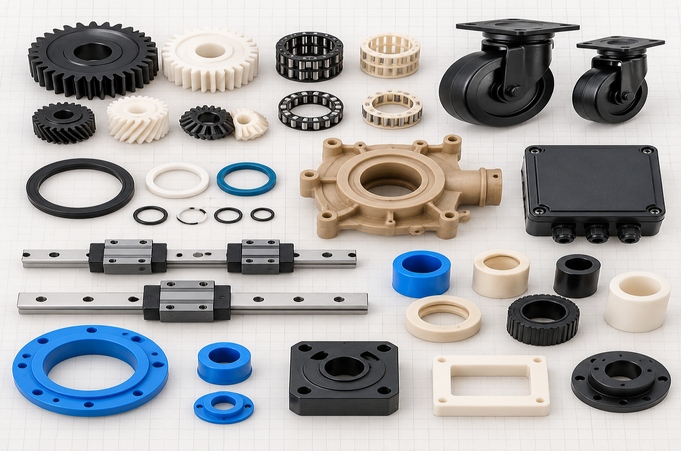
POM: A Practical Choice for Gears, Bushings, and Sliding Parts
Polyoxymethylene (POM), also known as acetal, is widely used in mechanical components because of its stiffness, dimensional stability, and relatively low friction. It is particularly useful in applications involving repeated movement and contact between component surfaces.
Typical applications include:
- Plastic gears and sprockets
- Bushings and bearing components
- Sliding blocks and guide elements
- Mechanical rollers and moving parts
- Precision components requiring dimensional stability
POM is often considered when a component needs smooth movement and reliable mechanical performance. Compared with some other engineering plastics, it can be a practical option for precision parts that experience repeated sliding or rotational contact.
However, POM is not automatically the best choice for every wear application. Contact pressure, sliding speed, lubrication, temperature, and the mating material all influence actual wear performance. The specific resin grade and component design should be evaluated together.
PA6 and PA66: Nylon for Load-Bearing Industrial Components
Polyamide, commonly known as nylon, is another important material family for industrial plastic parts. PA6 and PA66 offer a combination of mechanical strength, toughness, and wear resistance, making them suitable for various moving and load-bearing components.
PA6 is often considered when a balance of toughness, impact resistance, and mechanical performance is required. PA66 is frequently selected for applications that need higher stiffness and strength, although the actual performance depends on the specific grade and reinforcement.
Common applications include:
- Flange bushings and bearing sleeves
- Industrial rollers and wear pads
- Mechanical supports and structural components
- Gears and moving equipment parts
- Automotive and industrial machinery components
One important consideration is moisture absorption. Nylon can absorb moisture from its surrounding environment, which may influence dimensions, stiffness, and mechanical properties. For components with tight tolerances, engineers should consider the expected moisture conditions and the material's conditioned properties before finalizing the design.
For a more detailed comparison, see PA6 vs PA66: How to Choose Nylon for Precision Injection Molded Parts.
UHMWPE and HDPE: Options for Sliding and Abrasion Applications
Ultra-high-molecular-weight polyethylene (UHMWPE) is known for its low-friction surface and strong abrasion resistance. It is often considered for components that experience repeated sliding contact, particularly in material handling and conveyor systems.
Potential applications include:
- Conveyor wear strips and guide rails
- Sliding pads and wear liners
- Material handling components
- Protective surfaces exposed to repeated abrasion
High-density polyethylene (HDPE) also offers useful chemical resistance, low moisture absorption, and good impact performance. It can be considered for industrial parts where chemical exposure, moisture, and general wear are relevant factors.
Although UHMWPE and HDPE belong to the same polyethylene family, they should not be treated as interchangeable materials. UHMWPE is generally considered when sliding wear and abrasion are key concerns, while HDPE may be suitable for applications requiring a practical balance of chemical resistance, impact performance, and cost.
For either material, the component's load, operating speed, temperature, and structural requirements should be reviewed before selection.
PEEK: High-Performance Plastic for Demanding Environments
Polyether ether ketone (PEEK) is a high-performance engineering thermoplastic used in applications that require a combination of mechanical strength, thermal performance, and chemical resistance.
Depending on the grade, PEEK can be considered for industrial components exposed to elevated temperatures, mechanical stress, and demanding operating environments. It may be relevant for precision mechanical parts, specialized bearings, and components used in equipment where conventional plastics cannot meet the required performance.
However, PEEK is generally a more expensive material than standard engineering plastics such as POM and nylon. It should therefore be selected based on specific performance requirements rather than used as a default solution for all wear-resistant components.
For many industrial applications, POM, PA6, PA66, or UHMWPE may provide sufficient performance at a more practical material cost. The best choice depends on the operating conditions and the required service life.
Engineering Plastic Material Comparison for Industrial Applications
The following table provides a practical overview of commonly considered engineering plastics. It is intended as an initial selection guide rather than a substitute for grade-specific technical data sheets or application testing.
| Material | Key Characteristics | Potential Applications |
|---|---|---|
| POM | Low friction, stiffness, dimensional stability | Gears, bushings, sliders, rollers |
| PA6 | Toughness, mechanical strength, wear resistance | Bushings, washers, mechanical parts |
| PA66 | Stiffness, strength, thermal performance | Load-bearing parts, supports, industrial components |
| UHMWPE | Low friction, abrasion resistance | Wear strips, guide rails, sliding liners |
| HDPE | Chemical resistance, low moisture absorption, impact performance | Industrial covers, liners, general-purpose components |
| PEEK | High-temperature capability, mechanical and chemical performance | Specialized precision parts and demanding industrial applications |
There is no universally best engineering plastic. A POM gear may perform well in a precision transmission system, while a UHMWPE guide strip may be more appropriate for a conveyor with continuous sliding contact. The final decision should be based on the actual grade, operating environment, and component design.
How to Select the Right Material Based on Working Conditions
Before choosing a resin, engineers should define how the component will operate. A structured evaluation helps narrow down suitable materials and reduces the risk of selecting a plastic that performs well in theory but fails under actual working conditions.
Evaluate friction, load, and movement. Determine whether the part experiences sliding, rolling, rotational, or intermittent contact. A continuously sliding guide component has different requirements from a gear exposed to repeated torque.
Check operating temperature. Consider both continuous service temperature and short-term temperature peaks. Heat can influence stiffness, dimensional stability, creep, and wear behavior. The selected material grade must be suitable for the actual temperature range.
Understand moisture and chemical exposure. Industrial components may come into contact with water, oils, lubricants, cleaning chemicals, or process fluids. Nylon, polyethylene, POM, and PEEK have different chemical and moisture-related characteristics. Compatibility should be confirmed for the specific environment.
Define dimensional and mechanical requirements. Components such as gears, bearing sleeves, and guide elements may need precise dimensions and stable fitting relationships. Shrinkage, moisture absorption, thermal expansion, and molding orientation can influence the finished dimensions.
Consider the total manufacturing cost. Material price is only one part of the total cost. Tooling, machining, production volume, cycle time, inspection, assembly, and expected replacement frequency should also be considered.

Why Component Design Matters as Much as Material Selection
Even a high-performance engineering plastic can wear prematurely if the component is poorly designed. Material selection and part geometry should be evaluated together during the product development process.
For example, insufficient wall thickness may reduce structural rigidity, while sharp corners can create stress concentration. Poor alignment between mating components can also increase localized friction and accelerate wear.
Several design considerations are especially important for wear-resistant industrial parts:
- Contact surface design: Ensure that mating surfaces have suitable geometry and contact areas.
- Load distribution: Avoid unnecessary stress concentration and uneven loading.
- Clearance and tolerance: Allow for material shrinkage, thermal expansion, and moisture-related dimensional changes.
- Lubrication conditions: Determine whether the component operates dry or with external lubrication.
- Moldability: Consider wall thickness, draft angles, gate locations, and material flow when designing injection-molded components.
For custom parts, these factors should be reviewed before mold production. Early communication between the product designer and manufacturer can help identify potential issues before they become costly tooling or production problems.
Yistar provides custom engineering plastic components through CNC machining and injection molding. Its published product information includes gears, rollers, bearings, bushings, and other industrial components, with material options such as POM, PA6/PA66, HDPE, UHMWPE, ABS, and PEEK. Explore the custom CNC machined and injection molded engineering plastic parts to learn more about the available component solutions.
Why Work with Yistar for Custom Engineering Plastic Components?
Choosing an engineering plastic supplier involves more than finding a company that can provide a particular resin. The manufacturer also needs to understand the component's function, material requirements, processing method, and dimensional specifications.
Yistar Precision Manufacturing is based in Xiamen, China, and provides plastic injection molding, mold development, product customization, and assembly services. The company supports custom sampling, small-batch trial production, and mass production for applications including industrial machinery, automotive, electronics, and medical-related products.
For industrial machinery and automation applications, Yistar's published engineering plastic component range includes:
- Custom plastic gears and sprockets
- Rollers and pulleys
- Bushings and bearing components
- Guide rails and sliding components
- Washers and other customized mechanical parts
Depending on the project requirements, components can be manufactured through CNC machining or injection molding. CNC machining can be considered for prototypes and parts requiring machining from engineering plastic stock, while injection molding is suitable for producing customized plastic components with dedicated tooling.
Yistar also describes a customization workflow covering technical drawing confirmation, sample production, mass production, product inspection, assembly, and packaging. This process helps align manufacturing requirements with the customer's component specifications.
To discuss a custom industrial plastic component, visit Yistar's Contact Us page and provide the relevant drawings, material requirements, estimated quantity, and operating conditions.
Frequently Asked Questions About Wear-Resistant Engineering Plastics
Which engineering plastic is best for wear-resistant industrial components?
There is no single best material for every application. POM is commonly considered for gears, bushings, and sliding parts. PA6 and PA66 are suitable candidates for many load-bearing mechanical components, while UHMWPE is often considered for sliding and abrasion applications. PEEK may be appropriate for demanding environments involving higher temperatures or chemical exposure.
Is POM better than nylon for industrial gears?
POM is often selected for gears requiring low friction and dimensional stability. Nylon may be considered when toughness, mechanical strength, or impact performance is more important. The final choice depends on torque, speed, temperature, lubrication, noise requirements, and the specific resin grade.
Is UHMWPE suitable for conveyor guide rails?
UHMWPE is a common candidate for conveyor guide rails and wear strips because of its low-friction surface and abrasion resistance. Engineers should still evaluate load, operating speed, temperature, mounting method, and the material's suitability for the working environment.
Can engineering plastics replace metal components?
In selected applications, engineering plastics can replace metal components to reduce weight, friction, corrosion concerns, or operating noise. However, replacement requires a review of load capacity, stiffness, temperature, wear behavior, and service conditions. Not every metal part can be directly replaced with plastic.
What information is needed to select a custom engineering plastic material?
Useful information includes the component's 2D or 3D drawing, operating temperature, load, movement type, contact surface, chemical exposure, dimensional tolerances, expected production quantity, and any relevant industry requirements. These details help the manufacturer evaluate suitable material and processing options.
Can Yistar manufacture custom wear-resistant plastic components?
Yes. Yistar's published product range includes custom engineering plastic components such as gears, rollers, bearings, bushings, and other industrial parts. Its product information lists material options including POM, PA6/PA66, HDPE, UHMWPE, ABS, and PEEK, with CNC machining and injection molding available for customized manufacturing.
Should I choose CNC machining or injection molding for custom plastic parts?
CNC machining is worth considering for prototypes, smaller quantities, or components that need to be machined from plastic stock. Injection molding is generally more suitable for repeat production and complex geometries where dedicated tooling can support consistent manufacturing. The appropriate process depends on part design, material, quantity, and cost targets.
Conclusion: Match the Material to the Application
Selecting engineering plastics for wear-resistant industrial components requires a clear understanding of the component's working conditions. POM, PA6, PA66, UHMWPE, HDPE, and PEEK each offer different advantages, but their suitability depends on load, friction, temperature, moisture, chemical exposure, and dimensional requirements.
Rather than choosing a material based on one property, engineers should evaluate the complete application and confirm the performance of the specific resin grade. Combining appropriate material selection with sound component design and suitable manufacturing processes is essential for achieving reliable industrial parts.
For businesses developing custom gears, rollers, bushings, bearings, and other industrial plastic components, Yistar Precision Manufacturing offers CNC machining and injection molding solutions based on customer drawings and project requirements. Contact Yistar to discuss your component design and material selection needs.